 Check Price on Amazon
ASUS TUF Gaming GeForce RTX 5090 32GB GDDR7 OC Edition Gaming Graphics Card Buying Guide — Black Friday Deals 2026
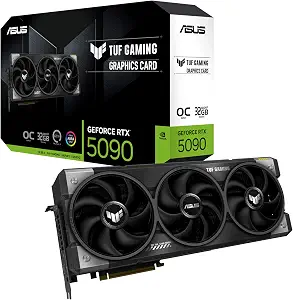
An RTX 5090 purchase is easier to assess when you separate concrete details from expectations. This ASUS TUF Gaming card lists 32 GB of GDDR7 memory, native display connections, two clock modes, axial-tech fans and stated dimensions. Those facts can help you decide whether the configuration fits your plans; they do not, by themselves, predict results for a particular game or workload. For Black Friday, treat the exact model and variant as the starting point, then check the offer details rather than assuming every RTX 5090 listing describes the same card. A useful decision journal can capture what matters to you, which details you have confirmed and what you still need to verify before buying.
This card is a strong fit for shoppers whose shortlist puts a specific connection layout or memory capacity near the top. Its listed graphics memory is 32 GB, and its memory type is GDDR7. The product also specifies three native DisplayPort 2.1a outputs and two native HDMI 2.1b outputs. Those details make it possible to compare the card against a planned display setup before checkout, without treating the output list as a promise about any particular screen configuration.
For this guide, the editorial label is Best for shoppers prioritizing listed native display connections: it reflects the explicit output details, not a measured advantage. The card also lists a default boost clock of 2550 MHz and an OC mode clock of 2580 MHz. Keep those entries in their stated modes when you compare Black Friday listings. A clock figure alone is not a guarantee of performance, and the available details do not establish how a system will behave in a particular workload.
Start with the task, then weigh the memory figure
The 32 GB graphics memory figure is a concrete point for comparing this card with your needs. Before treating capacity as a deciding factor, write down what you expect the PC to do: for example, which games, creative applications or other graphics workloads you intend to use. Then check the requirements and guidance relevant to those applications rather than assuming that a larger memory figure automatically improves every task. The provided specifications identify GDDR7 as the memory type, but they do not describe application results or guarantee a particular level of performance.
This is useful during Black Friday because a large headline specification can draw attention away from the job you actually need done. Compare the exact card variant and its listed details, and keep your own workload notes beside them. If memory capacity is a priority for your plans, record that as a reason to consider this configuration—not as proof that it is the right choice for every buyer. If it is not central to your plans, give other decision points, such as the display connections or physical dimensions, appropriate weight too.
Translate the native outputs into a display plan
The stated video outputs are native DisplayPort 2.1a x3 and native HDMI 2.1b x2. Begin by listing the displays you expect to connect and the input each one uses. Match those needs against the output types shown here, and check the exact display and connection requirements for your own setup. This turns the output list into a practical compatibility question without assuming which displays you own or what a particular arrangement can support.
During Black Friday comparisons, do not stop at a broad RTX 5090 label. Confirm that the listing is for this exact ASUS variant and that its output details match the configuration you intend to use. If you are comparing multiple cards, note the connection information for each one in the same format. The listed port count is useful for planning, but the supplied details do not establish display limits, resolutions or refresh rates. Verify those requirements against the materials for the exact products and displays before making a decision.
Read the clock modes without turning them into a promise
The specifications list a default mode with a 2550 MHz boost clock and an OC mode of 2580 MHz. Keep the two entries distinct when you compare configurations: one is identified as the default mode, and the other is identified as OC mode. The figures describe listed clock settings, not a guaranteed result for every system or workload. They also do not tell you how much difference you would notice in the activities you care about.
A Black Friday listing can make small specification differences feel decisive, so use the clock details as one comparison point rather than a shortcut to a performance conclusion. Confirm that the offer names the same OC Edition and examine how the listing presents the modes. If clock settings matter to your purchase, consult the product information for how the modes are selected and what conditions apply; those details are not included here. Keep your notes factual, and avoid comparing unlike modes as if they were identical conditions.
Check the stated footprint against your build plans
The listed card dimensions are 13.7″L x 5.7″W. Use that exact format when you check the space available in your intended build. Compare the stated length and width with the relevant clearances in your case, and account for any layout constraints you already know about. The available facts do not give a complete fit assessment for a particular case, so a measurement from one dimension alone should not settle the question.
This check is especially worthwhile before a Black Friday purchase, when it can be tempting to focus on the offer first and the build details later. Verify the dimensions for the exact card in the listing, then compare them with the space you have measured. If your setup has other physical constraints, confirm those separately rather than guessing from the product name. A short note recording the measurement you need to verify can prevent an avoidable mismatch between an attractive listing and your planned installation.
Give axial-tech fans a measured place in the decision
Axial-tech fans are the cooling feature identified in the provided details. That is useful information if you are comparing product descriptions, but it is not a complete account of cooling behavior, noise or temperatures. Those outcomes are not specified here. Consider the fan detail alongside the other facts you can verify, and look for the information you need about your priorities rather than filling gaps with assumptions.
For a Black Friday shortlist, you might note that the card lists axial-tech fans, then separately identify any unanswered questions that matter to you. Avoid treating the feature name as evidence of a particular acoustic or thermal result. The same careful approach applies when comparing other listings: distinguish a stated feature from a measured outcome or promise. If cooling behavior is central to your decision, confirm the relevant details for the exact card through its product information before relying on that expectation.
Key specs
| Graphics memory | 32 GB |
| Memory type | GDDR7 |
| Video outputs | Native DisplayPort 2.1a x3, Native HDMI 2.1b x2 |
| Default boost clock | Default mode: 2550 MHz(Boost clock) |
| OC mode clock | OC mode: 2580 MHz |
| Card dimensions | 13.7″L x 5.7″W |
| Cooling features | Axial-tech fans |
Make your Black Friday choice
A sound decision comes from matching the listed configuration to a real need: memory capacity, native display connections, the two clock modes, dimensions and the stated fan feature each answer a different question. None should stand in for details that have not been provided. Before acting on a Black Friday offer, verify the exact model and variant, review the listing’s terms and compare its stated specifications with your own requirements. Black Friday can be a useful time to make that comparison, but the label alone does not establish a discount or make the card a fit. Keep the offer, the product details and your build plan aligned before you decide.