Best Oled Monitor Buying Guide — Black Friday Deals 2026
An OLED monitor shortlist can quickly become a comparison of similar-looking gaming specifications. Start instead with the decisions that shape everyday use: screen size, resolution, display technology, surface finish, motion specifications and adaptive sync. The three monitors here all pair QHD-class resolution with a 240Hz refresh rate, but they differ in panel labeling, finish and listed sync support. Those distinctions can help narrow a choice before Black Friday offers add urgency. Treat the Best Overall and Best Budget labels as editorial signposts among these options, not as test results or claims about current prices. During Black Friday, verify the exact model and configuration attached to any offer, then compare it with the features you actually want.
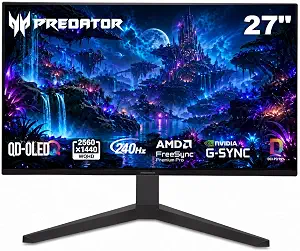
The Acer Predator X27U W1 earns the Best Budget label among the featured choices, but that editorial label does not promise a lower price or a current Black Friday discount. It is a 26.5-inch QD-OLED monitor with 2560×1440 resolution and a 240-hertz refresh rate. The listed response time is 0.03 milliseconds. Together, these details make it a useful option to compare for someone seeking a QHD gaming display in a slightly smaller stated screen size than the 27-inch alternatives here.
The matte finish differentiates the Acer from the glossy LG and gives shoppers a direct surface preference to weigh. Its listed adaptive-sync feature is FreeSync Premium, and the monitor has two HDMI ports. QD-OLED is the display technology named in the product information, so compare that label directly with the OLED and QD-OLED descriptions of the other shortlisted monitors rather than assuming the labels mean identical configurations. This model’s set of known details gives you several concrete comparison points without requiring guesses about unlisted features.
During Black Friday, consider the Acer if its screen size, matte finish, QD-OLED label and FreeSync Premium support line up with your own checklist. Then inspect the offer to ensure it refers to the X27U W1 rather than another Predator model or a different configuration. Compare the actual offer with the LG and Samsung options using the same priorities, not the Best Budget badge alone. If the advertised price is compelling but the exact monitor or configuration is unclear, resolve that uncertainty before choosing. The label identifies its role in this guide; it does not establish what the seller is charging.
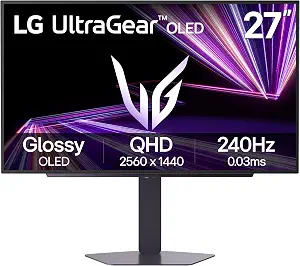
The LG 27GX704A-B is the Best Overall pick in this group for shoppers who want a clearly specified set of gaming features in one 27-inch OLED monitor. It pairs a 2560×1440 native resolution with a 240-hertz refresh rate and a listed response time of 0.03 milliseconds. Those figures make it a straightforward candidate to compare if your priority is a QHD display with high refresh-rate specifications. The Best Overall label is an editorial choice among these three monitors, not a claim that the LG has been tested against every alternative.
Its display type is OLED, and its glossy screen finish is an important preference to consider alongside that panel label. Think about where the monitor will sit and whether a glossy surface suits the viewing environment you have in mind. The listing also specifies FreeSync Premium Pro and G-Sync Compatible adaptive sync. If sync support is part of your shortlist, check the exact wording against the feature you want rather than treating refresh rate and adaptive sync as interchangeable. Two HDMI ports are listed, which gives you a concrete connection detail to compare with the devices you plan to use.
For Black Friday, this model makes sense to keep on your list if the combination of OLED, glossy finish, sync options and stated motion specifications matches your priorities. The offer itself still needs checking: confirm that it names the 27GX704A-B and the same configuration, then compare the price shown with other offers you are considering. Do not let the Best Overall label stand in for that check. Choose this LG when its specific feature mix is the reason you want it; if the finish or another listed specification is not your preference, compare the Acer and Samsung before deciding.
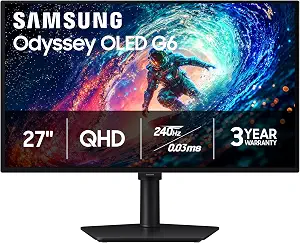
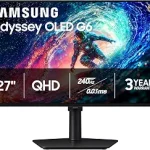
The Samsung Odyssey OLED G6 G61SH is the Best for a matte QD-OLED shortlist pick. That label points to the two listed details that may make it worth comparing: QD-OLED display technology and a matte finish. Its screen measures 27 inches, and the listing describes its resolution as QHD Wide 1440p. A 240Hz refresh rate and a 0.03-millisecond response time are also specified, giving shoppers motion-related details to place alongside the panel and finish choices.
FreeSync Premium is the stated adaptive-sync feature. Compare that wording with your own requirements and with the LG’s listed FreeSync Premium Pro and G-Sync Compatible support or the Acer’s FreeSync Premium feature. These are product-specific listings, not a reason to assume that every device or use case will behave the same way. The Samsung’s matte finish can also help settle a preference-based comparison: shoppers who want a matte surface can weigh it against the LG’s glossy finish, while the Acer also lists matte.
For Black Friday, put the G61SH on your shortlist if QD-OLED and matte are the combination you want to investigate. Verify the exact model name and 27-inch configuration on the offer page, then compare the displayed terms with the other monitors under consideration. The Best for a matte QD-OLED shortlist label is not a performance ranking or a claim about price. It simply makes the product’s stated panel technology and surface easy to identify. Use those facts, its listed motion specifications and its sync feature to decide whether it fits your priorities.
Key specs
Screen size
27 inches
Display technology
QD-OLED
Resolution
QHD Wide 1440p
Refresh rate
240Hz Refresh Rate
Response time
0.03 milliseconds
Adaptive sync
FreeSync Premium
Screen finish
Matte
Give the panel label and surface separate jobs
Display technology and screen finish describe different aspects of a monitor, so compare them as separate choices. The Acer and Samsung are identified as QD-OLED, while the LG is listed as OLED. The finish information draws another distinction: Acer and Samsung are matte, and LG is glossy. If you already have a preference for a surface, use it to narrow the field; if not, consider where the monitor will be used and which option seems more suitable for your viewing habits. The supplied details do not establish how any finish will look in a particular room, so treat this as a personal fit question.
Black Friday deal pages can emphasize a panel label or a headline feature, but neither should replace checking the complete model name. Keep a short list of the panel and finish you are considering, then confirm both on the exact product offer. Avoid assuming that two products with OLED in their descriptions share every specification. The Acer’s QD-OLED wording and the Samsung’s QD-OLED wording are explicit, while the LG is described as OLED. Compare what is actually listed, and leave unprovided details out of the decision rather than filling gaps with assumptions.
Choose a screen format that fits the way you work and play
The listed screen sizes are close, but not identical: Acer specifies 26.5 inches, while LG and Samsung each specify 27 inches. All three are positioned around QHD resolution, though the wording differs in the records: Acer and LG list 2560×1440, and Samsung lists QHD Wide 1440p. These details can help you decide what to compare, but they do not tell you how much desk space you have or what viewing distance suits you. Take those personal constraints into account before choosing between the models.
If you are shopping during Black Friday, avoid treating a small difference in screen size as a decisive advantage without considering your own setup. Check the exact model and resolution in the offer details, especially if several screen sizes or configurations appear together. You can write down your preferred size and resolution before browsing, then use that pair of requirements to filter the options. If both sizes seem appropriate, move on to finish, sync and connection details rather than stretching a minor distinction into a promise about picture quality.
Keep refresh rate, response time and sync in separate columns
Each monitor lists a 240-hertz refresh rate and a 0.03-millisecond response time. Those are separate specifications, so record each one independently instead of treating one as a substitute for the other. Adaptive sync is a third comparison point: Acer and Samsung list FreeSync Premium, while LG lists FreeSync Premium Pro and G-Sync Compatible. If a particular sync label matters to you, match the exact wording to your needs and verify the product listing rather than assuming that a similar monitor name means identical support.
A Black Friday comparison is easier to manage when you avoid ranking products from a single motion figure. Put the refresh-rate, response-time and sync information on separate lines, then check which details are relevant to your setup. The provided facts give you the listed values and names, but they do not establish how a monitor will perform with your particular system. Use the specifications to create a shortlist, and verify compatibility or any other requirement directly before purchasing if it is not covered by the information shown here.
Match the connection details to devices you intend to use
A monitor can look like a close match on display specifications and still need a careful connection check. The Acer and LG each list two HDMI ports. The available Samsung facts do not specify an HDMI-port count, so do not infer one way or the other from that omission. Make a note of the devices you plan to connect, identify which inputs you need, and check the exact monitor listing for the information relevant to your setup. This prevents a broad product description from standing in for a detail you need to confirm.
Use the same careful approach to model names during Black Friday. The offer should identify the Acer Predator X27U W1, LG 27GX704A-B or Samsung Odyssey OLED G6 G61SH you intend to buy. Confirm that the listed configuration matches the one you compared, and check any connection detail that matters before relying on an offer summary. If the port information is not clear, seek clarification before committing rather than assuming the specification from a different model applies.
Compare the actual offer, not the size of the sale message
A useful Black Friday comparison begins with a clear target model and a short list of required features. After that, compare the exact offer presented for each candidate. The supplied product information contains no prices or discount details, so it cannot establish which monitor is the lowest-priced choice or whether an offer represents a saving. Treat Best Budget as this guide’s editorial label, not a forecast of the price you will see. Check the model name and configuration first, then evaluate the actual terms shown to you.
It can help to write down a few priorities before browsing: preferred finish, display technology, screen size, sync label and connection needs. Give each one a simple importance level, then look at how well each product’s listed facts match. If the offer does not clearly identify the model or leaves an important detail unresolved, pause to verify it. A Black Friday countdown or prominent sale message is not a substitute for checking the monitor itself. Choose the offer that fits your priorities and is clearly for the configuration you selected.
Make your Black Friday choice
These three options share QHD-class resolution, a 240Hz refresh-rate listing and a 0.03-millisecond response-time listing, but their labels and finishes offer useful ways to distinguish them. Compare Acer’s QD-OLED and matte combination, LG’s OLED and glossy finish, and Samsung’s QD-OLED and matte finish alongside the sync details that matter to you. Before buying during Black Friday, confirm the precise model and configuration and compare the actual offer rather than assuming a label signals a discount. A short, fact-based checklist is a better guide than urgency.