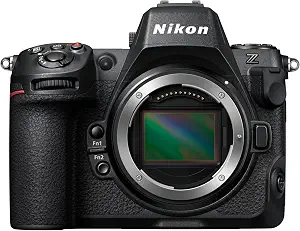
The Nikon Z 8 brings high-resolution still capture, multiple continuous-shooting options and advanced internal video recording together in one camera. That range makes the useful Black Friday question less about collecting the longest specification list and more about identifying which capabilities match your work. Start with the kinds of photographs and footage you expect to make, then compare the exact listing and variant against those needs. No particular Black Friday promotion should be assumed: evaluate the offer shown when you shop, along with what the listing says is included.
The details worth weighing are the 45.7MP sensor, autofocus features, recording formats and range of shooting rates. Each can matter differently to a photographer choosing between detailed stills, moving subjects and video projects. The guide below turns those specifications into practical decisions without assuming that every buyer needs every mode.
This camera is a fit to consider if your work crosses between high-resolution photographs and substantial video recording. Its 45.7MP stacked CMOS sensor and EXPEED 7 processing engine are central still-image specifications; internal 8K/60p and 4K/120p video add options for projects that call for those capture modes. The combination is notable as a set of choices, not a promise that one configuration is right for every assignment.
For a Black Friday decision, first separate must-have modes from features you might use only occasionally. The autofocus specification includes subject detection, 3D tracking and focus detection as low as -9 EV. Still-image formats include RAW 14-bit, High Efficiency RAW, 10-bit HEIF and JPEG 8-bit, while internal RAW video options are 12-bit N-RAW and ProRes RAW. Consider which of these choices fit your intended capture and finishing process, then verify that the offer is for the exact product and variant you mean to compare.
Resolve your still-image priorities before comparing offers
The 45.7MP stacked CMOS sensor gives you a clear starting point for deciding whether this camera’s still-image specification suits your work. Think about the detail you want to retain in the photographs you make and how you expect to handle the resulting images. The EXPEED 7 processing engine is also part of the listed sensor-and-processing combination, but the provided specifications do not establish how it will perform for a particular subject or workflow.
Use Black Friday browsing to compare the exact listing with that decision, rather than letting a promotion headline set your priorities. If high-resolution still capture is important, confirm the listed model and review the offer details. If video or fast sequences matter more, give those specifications equal attention instead of treating resolution alone as the deciding factor.
Make the focus specification answer a real shooting question
Subject detection and 3D tracking are the stated autofocus features, and focus detection is listed as low as -9 EV. Those details are relevant when you are considering how the camera’s focus options relate to your subjects and shooting conditions. For example, a photographer who follows subjects can decide whether subject detection and tracking belong on the must-have list; someone prioritizing focus in low-light conditions can note the stated -9 EV figure. Neither detail guarantees a particular result in every scene.
During a Black Friday comparison, write down the subjects and conditions you actually expect to encounter, then check the listing against the autofocus features provided here. Avoid assuming that a feature name alone settles the question: your subject matter and intended use should determine how much weight you give it.
Choose a sequence rate with the moment in mind
Continuous shooting options are listed at 20, 30, 60 and 120 fps. This gives you several stated rates to consider when deciding how you want to capture a changing moment. Rather than treating the largest figure as automatically preferable, ask which listed options are relevant to the subjects you photograph and whether continuous shooting is central to your work. The specification provides choices; it does not say that every rate suits every situation.
As you compare Black Friday offers, keep the shooting-rate details beside your own requirements. If you rarely use continuous shooting, it may deserve less attention than image formats or video modes. If sequence capture is a priority, verify that you are evaluating the intended model and make sure the listed options match the features you set out to find.
Match internal video modes to the finished project
Internal 8K/60p and 4K/120p video are the listed capture modes. Consider the kind of finished footage you want to create before deciding how important either mode is. A project built around one of these formats may make that specification a deciding point; for other work, the relevant question may simply be whether the listed modes match your planned capture. The facts do not establish which format will suit every editing setup or final delivery.
Black Friday can bring attention to a headline video figure, so keep the comparison grounded in your own project. Check the exact offer and variant, and compare the stated modes with the requirements you already identified. Do not assume that a larger or faster-sounding number is useful unless it serves the footage you intend to make.
Decide whether RAW recording belongs in your plan
The camera records internal 12-bit N-RAW and ProRes RAW video. These are distinct format choices to consider if RAW video is part of your intended process. Before treating either as a reason to buy, decide whether you want RAW recording in your project at all and how it fits the way you plan to work with footage. The available facts identify the formats but do not specify editing requirements, file sizes or compatibility with other equipment.
For a Black Friday purchase, make RAW video a deliberate checkbox rather than an assumed benefit. If it matters, confirm that the listing describes the camera and recording features you are comparing. If it does not, spend more of your attention on the capture modes or still-image options that better match your stated priorities.
Select still-image formats for your finishing choices
The listed still formats are RAW 14-bit, High Efficiency RAW, 10-bit HEIF and JPEG 8-bit. This range gives you formats to weigh according to how you want to capture and finish photographs. Decide which options you expect to use, and whether having multiple listed choices matters to your work. The specification does not establish that one format is best for every buyer, so the useful comparison is against your own preferred workflow.
When reviewing a Black Friday offer, confirm the exact model and look for the still-image format information relevant to your checklist. Avoid choosing on the basis of a format name you do not plan to use. A focused comparison helps distinguish features that support your work from those that are simply present in the specification.
Key specs
Sensor and processor
45.7MP stacked CMOS sensor and EXPEED 7 processing engine.
Autofocus
detects focus as low as -9 EV, combines subject detection and 3D tracking.
Video
Internal 8K/60p and 4K/120p video.
RAW video
Internal 12-bit N-RAW and ProRes RAW recording.
Still image formats
RAW 14-bit, High Efficiency RAW, 10-bit HEIF and JPEG 8-bit.
Continuous shooting
20, 30, 60 and 120 fps shooting options.
Make your Black Friday choice
A practical Black Friday plan is to rank your needs first: still-image detail, autofocus features, continuous shooting, internal video modes and recording formats. Then compare the exact Nikon Z 8 listing and variant against that list, and verify the offer details rather than assuming a discount, package or promotion. The best fit is the one whose stated capabilities align with the photographs and footage you plan to make—not simply the one with the most specifications you might never use.